FP Products recently changed its CEO and a new one came from within. We have been doing interaction training for years and wanted to give the new management a good start. The SmoothTeam simulation was used to develop the board and management team and involved their members.
A new CEO needs an understanding of the organisation and new perspectives
During the simulation we had a lot of discussions. This brought many new perspectives to our CEO. When there is a change of CEO, it is essential that the new person understands the situation, the background of people's mindsets and is able to start developing the management team effectively.
For the government, the simulation worked well
The board members fitted in very well. The board has been together for a long time and they are a familiar part of the company. In-house, board members attend company events. We also meet members of the management team outside of board meetings to maintain a good relationship.
The issues of interaction, cooperation and learning from each other discussed in the simulation also apply to government. All boards should be put in the classroom to learn how to interact - board interaction needs to be of a much higher quality than the chair just giving speeches from the head of the table.
Creativity - how can a group be more than the sum of its parts?
For a meeting to be useful and worthwhile, five times one must be more than five, i.e. the result must be more than the sum of the participants. Especially when it comes to creativity and its development, diversity is key. By first understanding diversity and building on it, you can get excellent results.
For creativity to work, one person must be able to give feedback freely to others, even on work in progress. This makes for an incredibly creative team, even among people who don't feel they are particularly creative. People have different characteristics and we have to find a way to make use of these differences.
Simulation developed transparency in a surprising way
After the simulation I heard, among other things, "oops, that was open, did I go too far". Not at all, as far as I can see! This open discussion was the best part of the simulation.
You cannot learn to interact by saying "let's interact" or "let's be open". We don't always act in a calm rational way, but the amygdala in our brain is activated, for example, in a state of overstimulation and can create a defensive reaction. In order to be able to communicate as freely as possible, even in tense situations, we need to learn a common way of communicating and reacting. Once you have learned a common language and a common way of responding, working is much easier and much more effective. When these and trust are in place, we don't fall into defensive reactions easily.
You can't interact by just listening. You have to be able to challenge constructively.
The powerful simulation was also inspiring
In the simulation, we encountered real situations that the team was inspired to think about. At the same time, these situations brought out the core issues that were important for us as a group to discuss. In this way, the fictional story got everyone involved in exactly the right issues, and at the same time the experience was fun and memorable for the participants.
Full marks for implementation - I can recommend to similar companies
The methodology was excellent and I give full marks to the facilitator as well. It would be very easy in such an exercise to not be able to dig out the kind of issues that we came up with during the simulation by discussion alone. I can recommend!
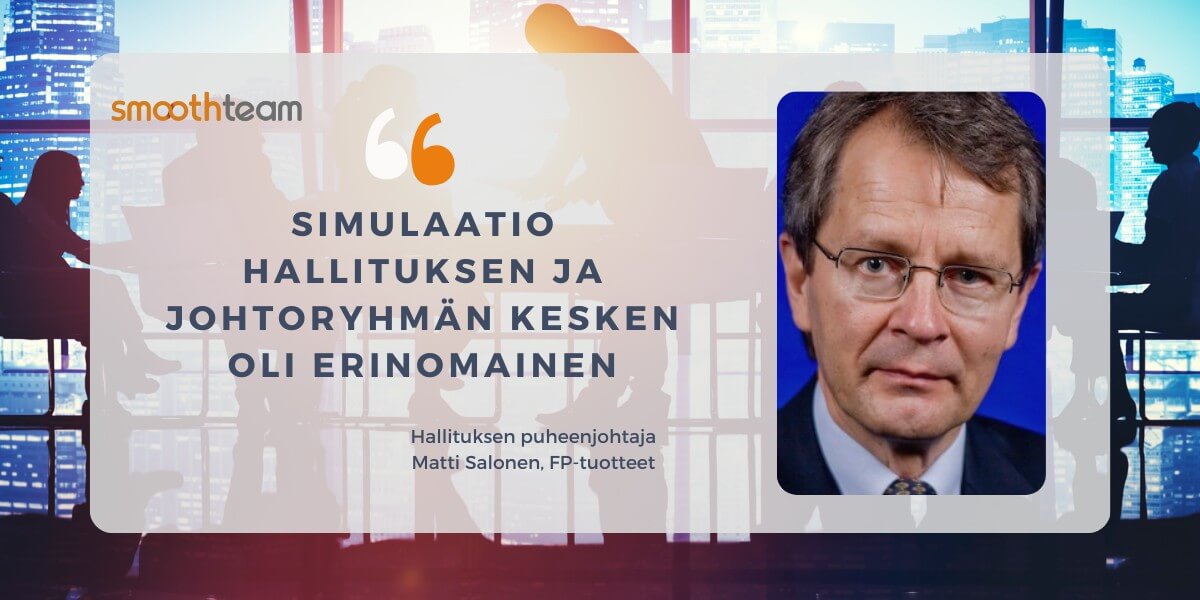
Matti Salonen
Chairman of the Board
FP-Tuotteet Oy